Have you ever tidied your home with real determination, only to watch the clutter creep back within weeks? Marie Kondo, the Japanese organizing consultant behind the bestselling book The Life-Changing Magic of Tidying Up, argues that this rebound effect is not a personal failure — it is the result of tidying the wrong way[1]. Her KonMari method proposes something radical: tidy once, tidy completely, and keep only the things that spark joy.
But the KonMari method is more than a cleaning technique. It is a mindfulness practice disguised as housework — and a growing body of research suggests that the state of our homes may genuinely influence our stress levels, focus, and emotional wellbeing[2][3]. In this guide, we explore how the method works, what science says about clutter and the mind, and how to try it yourself.
What Is the KonMari Method?
Developed by Marie Kondo over decades of obsessive fascination with organizing — she began reading home magazines at age five — the KonMari method turns conventional tidying advice upside down[1]. Instead of cleaning a little every day, room by room, Kondo recommends one intense, complete tidying "event." Instead of deciding what to throw away, you decide what to keep. The method rests on a few core principles:
- Tidy in one go, not little by little: Kondo argues that gradual tidying never produces the dramatic change in mindset needed to prevent rebound. A single thorough reset — which she admits may take up to six months — creates a visible transformation that motivates you to maintain it[1].
- Visualize your ideal lifestyle first: Before discarding anything, imagine in concrete detail how you want to live in your space. Then ask yourself why — several times over — until you reach the deeper purpose behind your wish to tidy.
- Discard first, organize later: Storage solutions come only after you have finished letting go. Kondo considers clever storage a trap: it merely hides the excess instead of resolving it.
- Sort by category, not by location: Because the same types of items are usually scattered across several rooms, tidying room by room means repeating the same work endlessly. Gather every item of one category — every piece of clothing, every book — into one place before deciding.
- Keep what sparks joy: The heart of the method. Hold each item in your hands and notice your body's response. If it lifts you, keep it. If not, thank it for its service and let it go.
The Right Order: Clothes Before Memories
Kondo insists that the sequence of categories matters as much as the sorting itself. Some objects carry functional value, others carry information, and some carry deep emotional weight — and the more emotional the object, the harder the decision[1]. Starting with easier categories trains your decision-making "muscle" before you face the difficult ones. The prescribed order is:
- Clothes: The easiest category, because their value is mostly practical.
- Books: Harder, because unread books whisper "someday" — a someday that, in Kondo's experience, rarely comes.
- Papers: Her rule of thumb is strict: discard nearly everything except documents currently in use, needed for a limited time, or required indefinitely.
- Komono (miscellany): The cables, gadgets, free promotional items, and spare buttons we keep "just because."
- Sentimental items: Photos, letters, and mementos come last, once your sense of what sparks joy has sharpened.
This gradient from easy to hard is psychologically astute. Research on clutter suggests that difficulty making decisions about possessions is closely linked to procrastination — we delay disposing precisely because each object demands an emotional verdict[4]. By postponing the hardest verdicts until your criteria are clear, the method reduces the friction that usually stalls decluttering projects.
What Science Says About Clutter and Your Mind
Kondo's claims about tidying transforming lives are personal observations, not clinical findings — she says so herself[1]. Yet independent research points in a similar direction: our physical surroundings appear to interact with our mental state in measurable ways.
Clutter and Stress Hormones
In a study of dual-income couples in Los Angeles, researchers analyzed how people described their own homes. Women who described their homes as cluttered or unfinished showed flatter daily cortisol slopes — a hormonal pattern associated with chronic stress and poorer health outcomes — while those who described their homes as restful showed healthier cortisol rhythms[2]. If you want to understand why this hormonal pattern matters, read our guide on how your body responds to chronic stress.
Clutter and Wellbeing at Home
A study of over 1,400 adults found that clutter had a strong negative association with "psychological home" — the sense of comfort, safety, and identity we derive from our living space — and, through it, with subjective wellbeing[3]. In other words, when possessions overwhelm a space, the home may stop functioning as a psychological refuge.
Clutter and Attention
Neuroscience offers a clue about why messy spaces feel draining. When multiple objects compete for our visual attention, they mutually suppress each other's neural representation, limiting the brain's processing capacity[5]. A visually calmer environment may simply leave more attention available for what matters to you.
Clutter and Everyday Behavior
Environment may even nudge our habits. In one experiment, women in a chaotic, messy kitchen who were primed to feel out of control ate roughly twice as many cookies as those in a tidy kitchen[6]. And clutter appears to be linked with procrastination across generations, suggesting a self-reinforcing loop: we delay tidying, the mess grows, and the growing mess makes starting even harder[4]. Health organizations note that decluttering may help reduce stress and improve mood, though individual results vary[7].
A note of caution: these studies show associations, not proof that tidying causes better mental health. A tidy home is not a treatment for anxiety or depression, and for people struggling with hoarding disorder, decluttering advice is no substitute for professional support. Think of tidying as one supportive habit among many — alongside sleep, movement, and practices like those in our complete guide to mental wellbeing.
How to Practice the KonMari Method: Step by Step
Step 1: Visualize Your Ideal Lifestyle
Before touching a single shelf, describe — ideally in writing — how you want your daily life to feel in your home. Be specific: what does your evening look like, what do you see when you walk in the door? Then ask yourself why you want this, several times, until you reach the underlying goal. For most people, Kondo observes, the final answer is simply to be happy[1].
Step 2: Gather One Entire Category in One Place
Start with clothes. Collect every single item from every closet, drawer, and coat hook in the house and pile it in one spot. Seeing the full volume at once is often a shock — most people own far more than they think — and that shock is part of the method's power[1].
Step 3: Hold Each Item and Ask: Does It Spark Joy?
Take each item into your hands one at a time. Notice your response — Kondo insists the body reacts before the mind rationalizes. Keep only what genuinely lifts you. If rational objections arise ("it might be useful someday," "it was expensive"), she suggests asking what role the item has already played in your life. Perhaps it taught you what does not suit you — a purpose fulfilled.
Step 4: Thank What You Let Go
Before discarding, thank the item — silently is fine. This ritual may sound eccentric, but it serves a practical psychological purpose: it reframes discarding from loss and guilt toward gratitude and closure, which makes the decision easier to complete.
Step 5: Give Everything You Keep a Designated Place
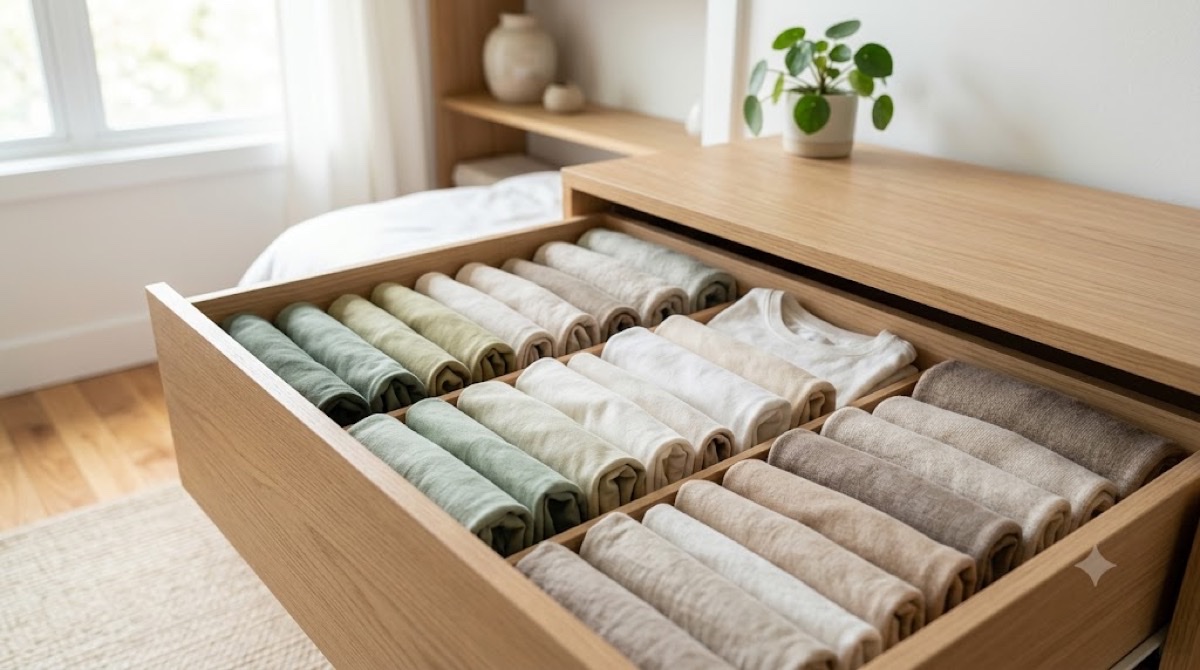
Only now do you organize. Every remaining object gets one home, and daily tidying shrinks to a single habit: returning things where they belong. Kondo's signature technique is vertical folding — clothes folded into compact rectangles and stored upright in drawers so you can see every item at a glance, like spines of books on a shelf[1].
Tidying as Mindfulness Practice
Perhaps the most overlooked aspect of the KonMari method is its contemplative quality. Kondo describes tidying as "a dialogue with oneself" and recommends doing it in silence — no television, no energetic music — ideally in the fresh clarity of early morning[1]. Handling each possession and asking how it makes you feel is, in essence, a repeated exercise in interoception: noticing your body's subtle responses. It resembles the attention training found in meditation or therapeutic journaling — a structured way of asking yourself what you truly value.
Kondo also observes that the process builds confidence in decision-making: choosing, hundreds of times in a row, what belongs in your life is practice for larger choices[1]. Her further claims — that clients change careers, improve relationships, or even lose weight after tidying — should be taken as anecdotes rather than evidence. But the core psychological logic is plausible: clarifying your environment can be a way of clarifying your priorities.
Common Pitfalls to Avoid
- Do not tidy other people's things. Kondo learned this the hard way as a teenager, secretly discarding her family's belongings — and losing their trust. Focus on your own possessions; family members often follow your example voluntarily[1].
- Do not pass your discards to family. Giving unwanted clothes to a sibling or parent may feel generous, but it usually just relocates the burden — and the guilt.
- Do not buy storage containers first. Storage gear purchased before discarding tends to become organized clutter.
- Do not demote unloved clothes to loungewear. Time at home is still your life; wearing things you dislike undermines the self-image the method aims to build.
- Be gentle with yourself. If letting go of possessions causes intense distress, or accumulation feels out of control, consider speaking with a mental health professional — hoarding disorder is a recognized condition that responds to therapy, not to stricter decluttering rules.
A Calmer Home, One Category at a Time
You do not need to embrace every mystical flourish of the KonMari method to benefit from it. At its core lies a simple, evidence-aligned idea: our surroundings and our minds are in constant conversation, and taking deliberate charge of one may support the other[2][3][7]. Start with a single category — perhaps just the clothes you wear at home — and notice how the process feels. A tidier space will not solve everything, but it may give your nervous system one less source of background noise. And that is a meaningful place to begin.
References
- Kondo M. "The Life-Changing Magic of Tidying Up: The Japanese Art of Decluttering and Organizing." Ten Speed Press, 2014. https://konmari.com/.
- Saxbe DE, Repetti R. "No Place Like Home: Home Tours Correlate With Daily Patterns of Mood and Cortisol." Personality and Social Psychology Bulletin, 2010. https://doi.org/10.1177/0146167209352864.
- Roster CA, Ferrari JR, Jurkat MP. "The dark side of home: Assessing possession 'clutter' on subjective well-being." Journal of Environmental Psychology, 2016. https://doi.org/10.1016/j.jenvp.2016.03.003.
- Ferrari JR, Roster CA. "Delaying Disposing: Examining the Relationship between Procrastination and Clutter across Generations." Current Psychology, 2018. https://doi.org/10.1007/s12144-017-9679-4.
- McMains S, Kastner S. "Interactions of Top-Down and Bottom-Up Mechanisms in Human Visual Cortex." Journal of Neuroscience, 2011. https://doi.org/10.1523/JNEUROSCI.3766-10.2011.
- Vartanian LR, Kernan KM, Wansink B. "Clutter, Chaos, and Overconsumption: The Role of Mind-Set in Stressful and Chaotic Food Environments." Environment and Behavior, 2017. https://doi.org/10.1177/0013916516628178.
- UPMC HealthBeat. "Is Clutter Linked to Stress, Anxiety, and Depression?" UPMC.com, 2021. https://share.upmc.com/2021/02/clutter-and-stress/.