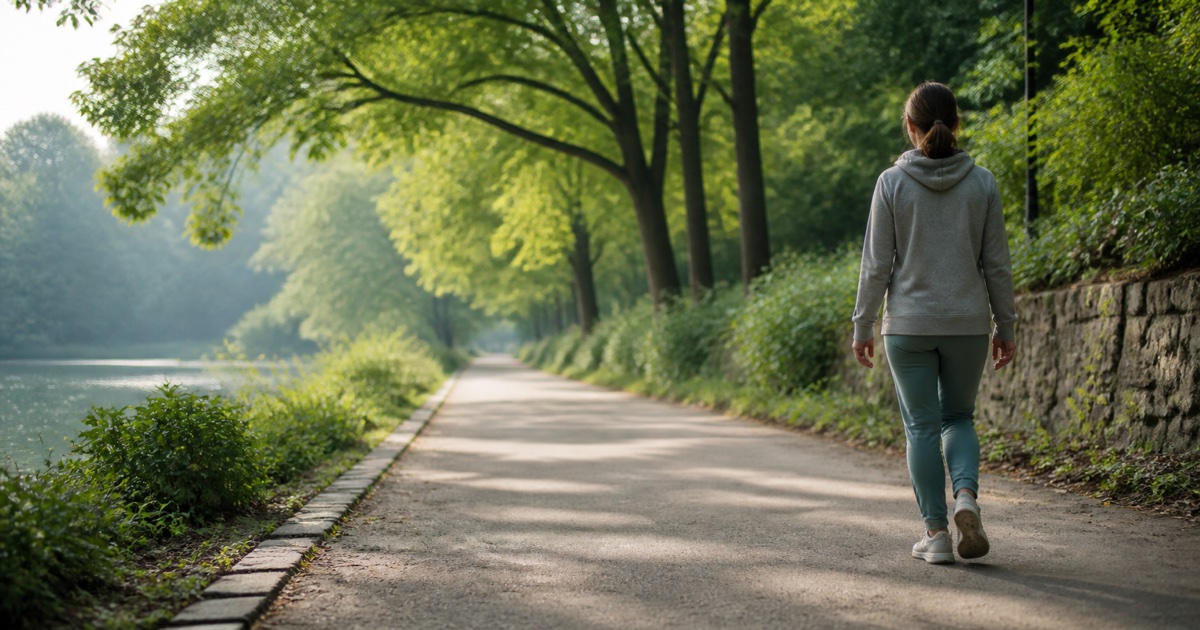
Your daily walk can be more than a way to get somewhere. Walking meditation brings attention to the steps, senses, and breath you already have, creating a small pause between the pressures of the day and your next task. It is a gentle, outdoor-friendly mindfulness practice—not a performance or a way to "empty" your mind.
What Is Walking Meditation?
Walking meditation is simply walking while deliberately noticing present-moment experience. You may feel the contact of each foot with the ground, hear a bird or traffic, notice the movement of air, and return to your breath when your thoughts pull you away. Thoughts will appear; the practice is the kind return, not forcing concentration.
In one small randomized trial involving people with psychological distress, a four-week mindful-walking program was associated with lower perceived stress and better quality of life than no intervention[1]. That result is encouraging, but it does not mean every walk will change stress or that walking meditation replaces therapy, medical care, or treatment for anxiety.
Why Pair Breath With a Daily Walk?
Your breath is portable: it is available on a sidewalk, a park path, or the walk home from work. Paying attention to it can make the walk feel less automatic and gives the mind one steady, neutral place to return. Research on slow, voluntary breathing suggests it can influence heart-rate variability and autonomic activity, although effects differ by technique, context, and person[2][3].
For a walking practice, "slow" should never mean strained. Trying to impose a very low breath rate while moving can create air hunger or dizziness. Let a comfortable walking pace lead; then allow an easy, unforced breath, often with an exhalation that is a little longer than the inhalation if that feels natural. You do not need breath holds, big breaths, or a perfect count.
How to Practice a Five-Minute Walking Meditation
Choose a familiar, reasonably quiet route where you can keep your attention on safety. A park is lovely, but a block near home works too. Outdoor mindful walking in nature has been studied in a student sample, with findings suggesting possible benefits for mood and sleep; the setting and study population still limit what we can generalize[4].
- Arrive before moving. Stand still for one or two comfortable breaths. Feel your feet in your shoes and look ahead for the route, other people, and traffic.
- Start at an ordinary pace. Walk naturally. Notice the heel, sole, and toes meeting the ground; there is no need to move in slow motion.
- Find the breath. Notice where breathing is easiest to sense—nostrils, chest, or belly. Keep it light and unforced.
- Use a flexible step rhythm. If it feels comfortable, notice two or three steps during inhalation and three or four during exhalation. Drop the pattern immediately if it makes you tense, breathless, or preoccupied.
- Open to the surroundings. Name one thing you can see, one sound you can hear, and one physical sensation. Then return to steps or breath.
- Begin again kindly. When planning, replaying, or worrying takes over, silently say “thinking,” then come back to the next footfall. This is the central repetition of the practice.
- Close the walk. Before rushing on, pause for one easy breath and notice whether your body or attention feels different. No particular result is required.
Simple Breath Anchors for Different Days
For a busy mind: feet first, breath second
When thoughts are loud, start with the physical rhythm: “left, right” or “lifting, moving, placing.” Add breath only after you feel settled. This prevents the practice from becoming another task to do perfectly.
For everyday stress: an easy longer exhale
Try noticing a slightly longer, completely comfortable exhale for a minute or two—without counting if counting feels stressful. Slow-breathing research is promising, but its authors also note that methods and outcomes vary; comfort is a more useful guide than chasing a physiological effect[2].
For a sensory reset: widen attention
Instead of fixing on breath, include the colors, temperature, sounds, and movement around you. This approach can be especially useful when inward breath focus feels too intense. The broader idea of mindfulness includes attention together with an accepting attitude; in an experimental study, that acceptance component was linked to lower stress reactivity[5].
Common Questions and Gentle Fixes
“I keep getting distracted.” That is expected. Each return to a footstep, sound, or breath is a repetition of the skill.
“I cannot match breath to steps.” Do not match them. Your breathing changes with hills, weather, pace, and conversation. Let it be irregular and simply notice it.
“I feel more anxious when I notice my breathing.” Shift your anchor outward to sights and sounds, or stop the exercise and take an ordinary walk. Breath-focused exercises are not comfortable for everyone. If you experience panic, shortness of breath, chest pain, faintness, or persistent distress, seek appropriate medical or mental-health support.
“Can I listen to something?” Yes. You might begin with one mindful minute before turning on a podcast. The practice need not be all-or-nothing; a repeatable, safe pause is more valuable than an idealized routine.
Make the Practice Part of Real Life
Attach walking meditation to a walk you already take: from the bus, around the block at lunch, or while taking a dog out. Start with five minutes two or three times a week. On other days, take one mindful breath at the door and notice three steps. Small, specific cues make the habit easier to remember.
For more ways to use breath without turning it into a demanding routine, explore our guide to the benefits of conscious breathing. If stress has been building for a long time, it may also help to understand how the body responds to chronic stress.
A mindful walk will not erase a difficult day. It can, however, offer a few minutes in which you notice that you are here: breathing, moving, and able to take the next step with a little more choice. Start with the route you already have, and let the practice stay simple.
References
- Teut M, Roesner EJ, Ortiz M, et al. “Mindful Walking in Psychologically Distressed Individuals: A Randomized Controlled Trial.” Evidence-Based Complementary and Alternative Medicine, 2013. https://doi.org/10.1155/2013/489856.
- Zaccaro A, Piarulli A, Laurino M, et al. “How Breath-Control Can Change Your Life: A Systematic Review on Psycho-Physiological Correlates of Slow Breathing.” Frontiers in Human Neuroscience, 2018. https://doi.org/10.3389/fnhum.2018.00353.
- Laborde S, Allen MS, Borges U, et al. “Effects of Voluntary Slow Breathing on Heart Rate and Heart Rate Variability: A Systematic Review and a Meta-Analysis.” Neuroscience & Biobehavioral Reviews, 2022. https://doi.org/10.1016/j.neubiorev.2022.104711.
- Ma J, Williams JM, Morris PG, Chan SWY. “Effectiveness of a Mindful Nature Walking Intervention on Sleep Quality and Mood in University Students During COVID-19.” Explore, 2023. https://doi.org/10.1016/j.explore.2022.08.004.
- Lindsay EK, Young S, Smyth JM, Brown KW, Creswell JD. “Acceptance Lowers Stress Reactivity: Dismantling Mindfulness Training in a Randomized Controlled Trial.” Psychoneuroendocrinology, 2018. https://doi.org/10.1016/j.psyneuen.2017.09.015.
Frequently Asked Questions
How long should a walking meditation be?
Start with five minutes or even one mindful minute of a walk you already take. A short practice that feels safe and repeatable is enough.
Should I count steps while breathing?
Only if it feels comfortable. Your pace and breathing naturally change, so let go of counting if it creates tension, breathlessness, or distraction.
What if breath focus makes me anxious?
Shift attention to sights, sounds, or the feeling of your feet, or stop the exercise. Seek appropriate support if anxiety, panic, or distress persists.