If you have been researching gut health, you have likely come across the term "butyric acid" — or butyrate, as it is often called in scientific literature. This short-chain fatty acid may not be a household name, but it plays a foundational role in keeping your digestive system healthy. From nourishing the cells lining your colon to reducing inflammation, butyric acid is among the most important compounds your gut produces.[1]
What Is Butyric Acid?
Butyric acid (butyrate) is a short-chain fatty acid produced when beneficial bacteria in your colon ferment dietary fiber and resistant starch. Along with acetate and propionate, it is one of the three main SCFAs — yet butyrate stands out for its outsized impact on gut health. Despite making up only about 15% of total SCFAs in the colon, it serves as the primary energy source for colonocytes, the cells that line your large intestine.[1]
The key butyrate-producing bacteria in the human gut include Faecalibacterium prausnitzii and Eubacterium rectale/Roseburia spp., which ferment fiber into butyrate as a metabolic byproduct.[2] This means that the food you eat directly influences how much butyrate your body produces.
How Butyrate Strengthens the Intestinal Barrier
Your intestinal lining is more than a passive wall — it is a dynamic barrier that selectively absorbs nutrients while keeping harmful substances out. When this barrier weakens, a condition sometimes called "leaky gut" or increased intestinal permeability, undigested food particles and bacterial toxins can enter the bloodstream, triggering inflammation and immune responses.[3]
Butyrate helps reinforce this barrier through several mechanisms:
- Tight junction assembly: Butyrate activates AMP-activated protein kinase (AMPK), which promotes the assembly of tight junction proteins between epithelial cells. These tight junctions are the "seals" that control what passes through the intestinal lining.[3]
- Mucin production: Butyrate stimulates the production of MUC2 mucin, a key component of the protective mucus layer that coats the intestinal surface.[4]
- Anti-inflammatory action: By inhibiting histone deacetylase (HDAC), butyrate suppresses NF-κB activation — a major driver of intestinal inflammation. This helps reduce the production of pro-inflammatory cytokines.[5]
- Antimicrobial peptide expression: Butyrate upregulates the expression of LL-37, an antimicrobial peptide that helps defend against harmful pathogens in the gut.[4]
Together, these mechanisms make butyrate one of the most important compounds for maintaining intestinal barrier integrity.
Butyric Acid and IBS — What Research Shows
Irritable bowel syndrome (IBS) affects an estimated 10–15% of the global population, causing symptoms like abdominal pain, bloating, and irregular bowel habits. Emerging research suggests that butyrate may play a role in managing these symptoms.[6]
A 2025 randomized, placebo-controlled clinical trial investigated calcium butyrate supplementation in children and adolescents with IBS. The study found that butyrate supplementation led to a significant reduction in IBS symptom severity and modulated gut microbiota composition toward a healthier profile.[6]
Research also indicates that IBS patients often have altered gut microbiota with reduced populations of butyrate-producing bacteria.[7] This observation has led scientists to explore whether increasing butyrate levels — through diet, probiotics, or direct supplementation — could help restore microbial balance and reduce symptoms.
A study by Vanhoutvin et al. demonstrated that butyrate enemas increased rectal compliance and reduced visceral sensitivity in healthy volunteers, suggesting a potential role in conditions associated with visceral hypersensitivity, such as IBS.[8]
It is important to note that while these findings are promising, the evidence base for butyrate supplementation specifically in IBS is still developing. Results from individual studies vary, and more large-scale randomized controlled trials are needed to establish clear clinical guidelines.
Supplementation: Forms and What to Know
If you are considering butyrate supplementation, understanding the available forms can help you make an informed decision:
- Sodium butyrate: The most common and widely studied form. It delivers butyrate directly but is absorbed quickly in the upper gastrointestinal tract, which means less reaches the colon where it is most needed. Typically available in doses of 150–300 mg per capsule.
- Tributyrin: A triglyceride composed of three butyrate molecules attached to glycerol. It acts as a prodrug, releasing butyrate more gradually during digestion, which may improve delivery to the colon. Some preliminary evidence suggests it may be better tolerated than sodium butyrate.
- Calcium butyrate: Similar to sodium butyrate but bound to calcium instead. Used in recent clinical studies, including the 2025 pediatric IBS trial mentioned above.[6]
- Microencapsulated butyrate: Newer formulations coat butyrate in lipid capsules designed to resist stomach acid and release the compound in the colon. This may improve bioavailability at the target site.
Dosage considerations: Clinical studies have used varying doses, typically ranging from 300 mg to 1,200 mg of butyrate per day. There is no officially established recommended daily intake, so it is advisable to consult a healthcare professional before starting supplementation, especially if you have existing digestive conditions.
A note on supplements: butyrate products are sold as food supplements, not medicines. They are not assessed for efficacy before sale, and the amount in a capsule is not independently verified in the way a licensed medicine would be. Dose ranges quoted from trials are what researchers used under supervision, not a recommendation. If you are considering supplementation, discuss it with a clinician or dietitian who knows your history.
Foods That Naturally Boost Butyrate Production
Before turning to supplements, consider that your diet can significantly influence how much butyrate your gut naturally produces. Eating foods that feed butyrate-producing bacteria is a foundational strategy for gut health:[2]
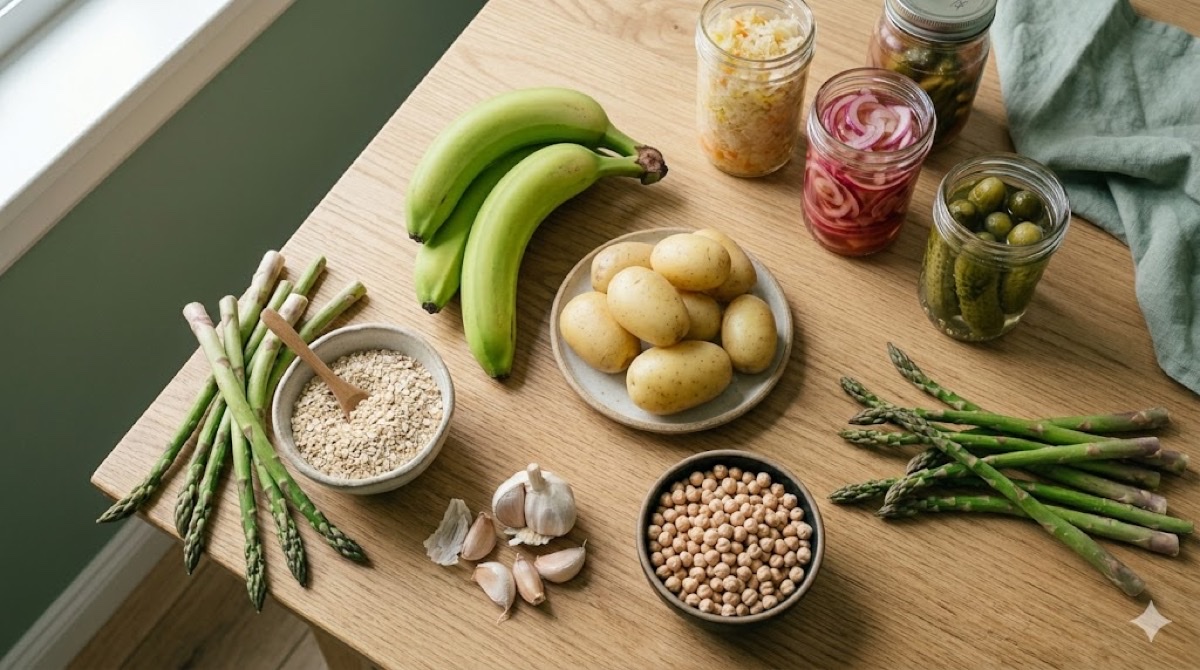
- Resistant starch: Found in cooled potatoes, green bananas, and oats. Resistant starch escapes digestion in the small intestine and is fermented by colonic bacteria into butyrate.
- Inulin-rich foods: Chicory root, Jerusalem artichokes, garlic, onions, and asparagus contain inulin, a prebiotic fiber that promotes butyrate production.
- Oat bran and whole grains: These provide beta-glucan and other fermentable fibers that support SCFA production.
- Legumes: Lentils, chickpeas, and beans are rich in fiber that feeds beneficial gut bacteria.
- Cooked and cooled grains: The process of cooking and cooling rice, pasta, or potatoes increases their resistant starch content, giving butyrate-producing bacteria more to ferment.
For a comprehensive approach to IBS-friendly eating, see our guide to the low FODMAP diet. If you are interested in how gut health connects to your overall well-being, our article on the gut health and mood connection explores this relationship in depth.
Practical Tips for Getting Started
Whether you choose to increase butyrate through diet, supplementation, or both, here are some practical guidelines:
- Start with food first: Before adding supplements, try to increase your intake of fiber-rich and resistant starch foods. This supports your entire gut ecosystem, not just butyrate production.
- Introduce fiber gradually: If your current fiber intake is low, increase it slowly over several weeks to minimize bloating and gas — common side effects when your gut bacteria adjust to more fermentable substrate.
- Consider a butyrate-producing probiotic: Certain probiotic strains, including Clostridium butyricum, have been studied for their ability to directly produce butyrate in the gut.[7]
- Pair supplementation with dietary fiber: Supplements work best alongside a diet that supports the overall gut microbiome. Butyrate supplementation is not a substitute for adequate fiber intake.
- Be patient: Changes in gut microbiota composition and butyrate production take time. Most studies showing benefits used supplementation periods of 4–12 weeks.
Important Considerations
Butyrate supplementation appears to be generally well tolerated in clinical studies, with most participants reporting no serious adverse effects. However, individual responses vary. Some people may experience mild digestive discomfort when first starting supplementation or increasing fiber intake.
If you have been diagnosed with IBS, inflammatory bowel disease, or another digestive condition, consult with your healthcare provider before starting any new supplement. Butyrate is a complement to — not a replacement for — medical treatment and professional dietary guidance.
Supporting Your Gut From the Inside Out
Butyric acid may be produced by microscopic bacteria, but its impact on your digestive health is significant. From fueling the cells that line your colon to strengthening the barrier that protects you from harmful substances, butyrate is a key player in gut health. Whether you increase your intake through fiber-rich foods, fermented ingredients, or targeted supplementation, every step toward supporting your butyrate-producing bacteria is a step toward a healthier gut.
Start with one change today — add a serving of resistant starch to your meal, try a prebiotic-rich food, or simply eat more vegetables. Your gut bacteria will do the rest.
References
- Berni Canani R, et al. "Potential beneficial effects of butyrate in intestinal and extraintestinal diseases." World Journal of Gastroenterology, 2011. https://doi.org/10.3748/wjg.v17.i12.1519.
- Louis P, Flint HJ. "Diversity, metabolism and microbial ecology of butyrate-producing bacteria from the human large intestine." FEMS Microbiology Letters, 2009. https://doi.org/10.1111/j.1574-6968.2009.01514.x.
- Peng L, et al. "Butyrate enhances the intestinal barrier by facilitating tight junction assembly via activation of AMP-activated protein kinase in Caco-2 cell monolayers." Journal of Nutrition, 2009. https://doi.org/10.3945/jn.109.104638.
- Hamer HM, et al. "Review article: the role of butyrate on colonic function." Alimentary Pharmacology & Therapeutics, 2008. https://doi.org/10.1111/j.1365-2036.2007.03562.x.
- Segain JP, et al. "Butyrate inhibits inflammatory responses through NFκB inhibition: implications for Crohn's disease." Gut, 2000. https://doi.org/10.1136/gut.47.3.397.
- Cristofori F, et al. "Calcium butyrate efficacy in pediatric irritable bowel syndrome: Randomized placebo-controlled multiomics-based clinical trial." Journal of Pediatric Gastroenterology and Nutrition, 2025. https://doi.org/10.1002/jpn3.70154.
- Di Pierro F, et al. "Irritable Bowel Syndrome with Diarrhea (IBS-D): Effects of Clostridium butyricum CBM588 Probiotic on Gastrointestinal Symptoms, Quality of Life, and Gut Microbiota." Microorganisms, 2025. https://doi.org/10.3390/microorganisms13051139.
- Vanhoutvin SA, et al. "The effects of butyrate enemas on visceral perception in healthy volunteers." Neurogastroenterology and Motility, 2009. https://doi.org/10.1111/j.1365-2982.2009.01324.x.
- Eetemadi A, Tagkopoulos I. "Methane and fatty acid metabolism pathways are predictive of Low-FODMAP diet efficacy for patients with irritable bowel syndrome." Clinical Nutrition, 2021. https://doi.org/10.1016/j.clnu.2020.12.041.
Frequently Asked Questions
What does butyric acid do for gut health?
Butyric acid (butyrate) is the primary energy source for colonocytes — the cells lining your colon. It strengthens the intestinal barrier by promoting tight junction assembly, stimulates protective mucus production, and has anti-inflammatory properties through HDAC inhibition.
Should I take a butyrate supplement for IBS?
Emerging research suggests butyrate supplementation may help reduce IBS symptom severity, but the evidence is still developing. A 2025 clinical trial found benefits with calcium butyrate in pediatric IBS patients. Consult your healthcare provider before starting any supplement.
What foods increase butyrate production naturally?
Foods rich in resistant starch (cooled potatoes, green bananas), inulin (garlic, onions, asparagus), oat bran, whole grains, and legumes feed butyrate-producing bacteria in your colon, supporting natural butyrate production.
How long does it take for butyrate supplements to work?
Most clinical studies showing benefits used supplementation periods of 4 to 12 weeks. Changes in gut microbiota composition and butyrate production take time, so consistency is important.