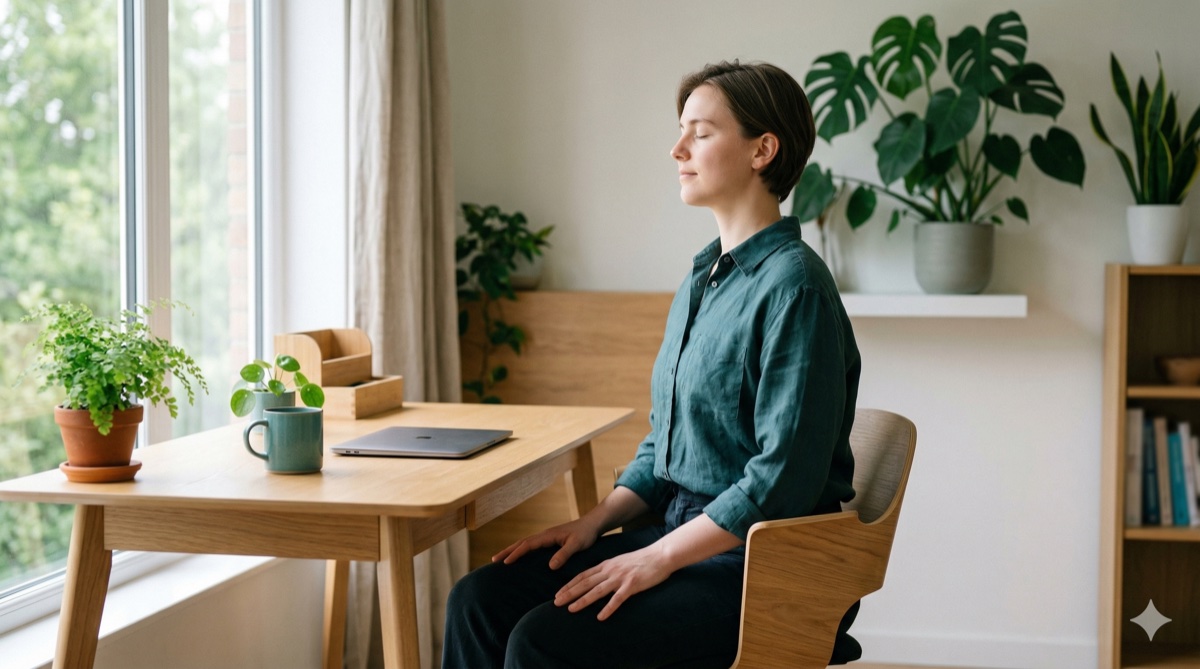
Take a deep breath right now. Did your chest rise, or did your belly expand? If you're like most people working at a desk, you probably breathed shallowly into your upper chest. The way you sit profoundly affects how you breathe—and how you breathe affects everything from your energy levels to your stress response[1].
Understanding the Posture-Breath Connection
Your diaphragm—a dome-shaped muscle beneath your lungs—is your primary breathing muscle. When functioning optimally, it descends as you inhale, creating a vacuum that draws air deep into your lungs. But when you slouch, this elegant mechanism gets compromised.
A slouched posture compresses the abdominal cavity, leaving nowhere for your diaphragm to descend. Your body compensates by recruiting secondary breathing muscles in your neck and shoulders. Over time, this creates a cascade of problems: tense shoulders, shallow breathing, reduced oxygen delivery, and heightened stress levels.
How Sitting Habits Affect Your Breathing Capacity
The Slouched Position
When you round your shoulders and collapse your chest forward—common after hours at a computer—several things happen:
- Reduced lung capacity: Research suggests slouched sitting can reduce lung capacity by up to 30%.
- Diaphragm compression: The collapsed position prevents your diaphragm from moving through its full range.
- Accessory muscle recruitment: Neck and shoulder muscles take over, creating tension and fatigue.
- Decreased oxygen delivery: Shallow breathing means less oxygen reaching your brain and tissues.
The Forward Head Posture
When your head juts forward toward your screen, it adds significant strain to your neck. For every 2.5 centimeters your head moves forward, the effective weight on your spine increases dramatically. This forward head position also restricts airway passage and encourages shallow, upper-chest breathing.
The Crossed-Leg Effect
Sitting with legs crossed might feel comfortable, but it tilts your pelvis and compresses your abdomen. This position further limits diaphragm movement and can contribute to circulatory issues in your legs.
The Science Behind Better Breathing
Diaphragmatic breathing—also called belly breathing—activates your vagus nerve, which triggers the parasympathetic nervous system. This "rest and digest" response lowers heart rate, reduces blood pressure, and promotes a state of calm. When poor posture prevents diaphragmatic breathing, you miss out on these benefits.
Studies have shown that improving posture can immediately increase tidal volume (the amount of air moved during normal breathing) and improve oxygen saturation levels. The good news? You can begin correcting these patterns today.
Gentle Stretches to Open Your Chest and Diaphragm
These stretches counteract the effects of prolonged sitting and create space for deeper, fuller breathing. Practice them slowly and mindfully.
1. Doorway Chest Stretch
This classic stretch opens the pectoral muscles that tighten from forward-reaching.
- Stand in an open doorway.
- Place your forearms on the doorframe at shoulder height.
- Step one foot through the doorway.
- Gently lean forward until you feel a stretch across your chest.
- Hold for 30–60 seconds, breathing deeply throughout.
- Repeat 2–3 times.
2. Seated Chest Opener
You can do this stretch right at your desk.
- Sit tall on the edge of your chair.
- Reach your arms behind you and interlace your fingers.
- Straighten your arms and lift them gently away from your body.
- Draw your shoulder blades together.
- Hold for 30 seconds while breathing deeply into your chest.
3. Cat-Cow for Spinal Mobility
This movement creates space throughout your entire torso.
- Start on your hands and knees.
- Inhale as you arch your back, lifting your chest and tailbone (cow).
- Exhale as you round your spine, tucking your chin and tailbone (cat).
- Continue for 10 slow cycles, coordinating breath with movement.
4. Side-Body Stretch
This stretch creates space between your ribs for fuller breaths.
- Stand or sit tall.
- Raise your right arm overhead.
- Lean gently to the left, creating a crescent shape with your body.
- Breathe deeply into your right ribcage.
- Hold for 30 seconds, then switch sides.
Quick Desk Exercises for Remote Workers
For those working from home, these exercises take just minutes and can be done without leaving your workspace.
Posture Reset (Every Hour)
Set an hourly reminder to perform this quick reset:
- Uncross your legs and plant feet flat on the floor.
- Roll your shoulders back and down.
- Lengthen your spine as if a string pulls the crown of your head upward.
- Take 5 deep diaphragmatic breaths.
The 2-Minute Breathing Break
This combines postural awareness with conscious breathing:
- Sit at the edge of your chair with feet flat.
- Place one hand on your chest, one on your belly.
- Inhale for 4 counts, feeling your belly hand rise.
- Exhale for 6 counts, feeling your belly hand fall.
- Continue for 2 minutes.
Shoulder Blade Squeezes
This strengthens the muscles that maintain good posture:
- Sit or stand tall.
- Imagine squeezing a pencil between your shoulder blades.
- Hold for 5 seconds.
- Release and repeat 10 times.
Chin Tucks
This corrects forward head posture:
- Sit tall with ears aligned over shoulders.
- Gently draw your chin straight back (not down).
- You should feel a subtle stretch at the base of your skull.
- Hold for 5 seconds and repeat 10 times.
Seated Spinal Twist
This releases tension and creates space for breathing:
- Sit tall in your chair.
- Cross your right leg over your left.
- Place your left hand on your right knee.
- Gently twist to the right, breathing deeply.
- Hold for 30 seconds, then switch sides.
Building Better Habits
Awareness is the first step. Throughout your day, periodically check in with your body:
- Are your shoulders creeping toward your ears?
- Is your head jutting forward?
- Are you breathing shallowly?
- Is your back rounded?
When you notice these patterns, simply reset your posture and take three deep breaths. Over time, this awareness becomes automatic.
Creating Your Breathing-Friendly Workspace
Monitor Position
Position your screen at eye level to prevent forward head posture. Use a monitor riser or stack of books if needed.
Chair Height
Your feet should rest flat on the floor with knees at approximately 90 degrees. This pelvic position supports your spine and allows your diaphragm to move freely.
Regular Movement
No posture is perfect if held for hours. Stand, stretch, and move every 30–60 minutes. Consider a standing desk or alternating between sitting and standing throughout your day.
Starting Your Practice
Begin with small, consistent changes. Choose one stretch and one desk exercise to practice daily. Set reminders on your phone or computer. Notice how your breathing—and your overall sense of wellbeing—changes as you create space in your body.
Remember, your posture is a habit formed over years. Be patient with yourself as you relearn how to sit and breathe. Each conscious breath in an aligned posture is a step toward better health, more energy, and greater calm.
References
- Kapreli S, Ersöz M, Öztürk GT, Hayran O. "Effects of posture on respiratory muscle strength and pulmonary function." Journal of Physical Therapy Science, 2010. https://doi.org/10.1589/jpts.22.7.
- Lin F, Parthasarathy S, Taylor SJ, et al. "Effect of body position on pulmonary function." Annals of the American Thoracic Society, 2018.
- Behm DG, Blazevich AJ, Kay AD, McHugh M. "Considerations for health and fitness professionals when employing flexibility." Sports Medicine, 2016.
- Courtiade B, Gimbert C, Biot L. "Effect of the sitting posture on the configuration of the trunk." European Spine Journal, 2018. DOI.
- Gordon BA, Wood BT, Alexander J, et al. "The impact of posture on respiratory function." Journal of Physical Therapy Science, 2021. DOI.