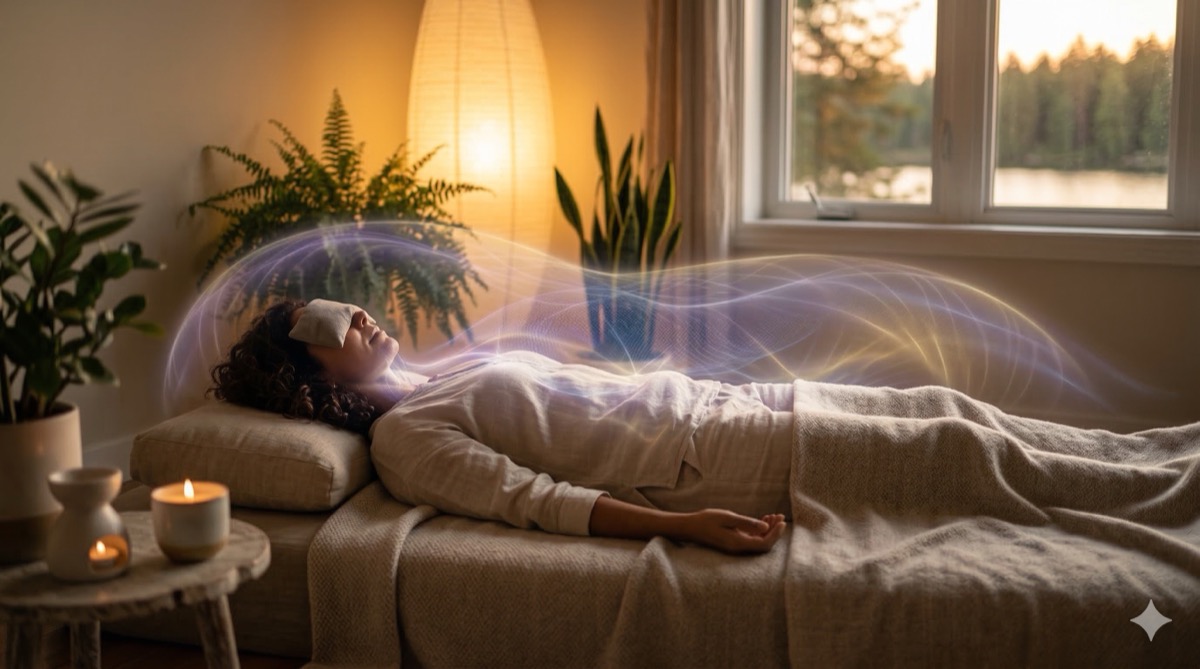
In a world that glorifies busyness, the practice of yoga nidra offers a radical invitation: to rest completely while remaining fully aware. Often called "yogic sleep," this ancient technique guides you into a state between waking and sleeping where profound healing and restoration occur[1].
What Is Yoga Nidra?
Yoga nidra translates as "yogic sleep" or "sleep of the yogis." Unlike regular sleep, yoga nidra is a state of conscious relaxation. You lie down comfortably while a guided practice leads you through various stages of awareness, eventually reaching a state where your body sleeps while your mind remains alert.
The Science Behind Yoga Nidra
During yoga nidra, your brain waves slow from beta (active thinking) through alpha (relaxed alertness) into theta (deep relaxation) and sometimes delta (deep sleep) states. In this deep relaxation:
- Cortisol levels decrease significantly.
- The parasympathetic nervous system activates.
- The body's natural healing mechanisms engage.
- Stress hormones are cleared from your system.
Benefits of Regular Practice
Physical Benefits
- Reduced muscle tension and chronic pain.
- Improved sleep quality.
- Enhanced immune function.
- Lower blood pressure.
- Better hormonal balance.
Mental and Emotional Benefits
- Decreased anxiety and depression.
- Improved emotional regulation.
- Enhanced creativity and problem-solving.
- Better focus and concentration.
- Reduced symptoms of PTSD.
Spiritual Benefits
- Deeper self-awareness.
- Connection to inner wisdom.
- Sense of wholeness and integration.
- Access to subconscious mind for transformation.
What Happens During a Session
A typical yoga nidra practice lasts 20–45 minutes and includes these stages:
1. Preparation
You lie down in savasana (corpse pose), making yourself as comfortable as possible with blankets and pillows. The room should be warm and quiet.
2. Sankalpa (Intention Setting)
You silently repeat a personal affirmation or intention. This seeds your subconscious with positive change.
3. Body Scan
The guide leads awareness through different body parts, promoting deep relaxation and release of physical tension.
4. Breath Awareness
Focusing on natural breathing patterns further calms the nervous system and quiets the mind.
5. Opposite Sensations
You're invited to experience contrasting sensations (hot/cold, heavy/light) to access deeper brain states.
6. Visualization
Guided imagery activates the creative, intuitive parts of your brain.
7. Return
Gradually, you're guided back to full awareness, feeling refreshed and restored.
How to Practice
You don't need any special equipment or flexibility. Simply:
- Find a quiet, comfortable space where you won't be disturbed.
- Lie down on your back with arms by your sides.
- Make yourself warm and comfortable with blankets.
- Use an eye pillow if helpful.
- Listen to a guided yoga nidra recording.
- Allow yourself to drift—there's nothing to "do".
When to Practice
- Morning: Sets a calm tone for the day ahead.
- Afternoon: A powerful alternative to a nap for energy restoration.
- Evening: Prepares body and mind for restful sleep.
- During stress: An excellent reset when feeling overwhelmed.
Tips for Beginners
- Start with shorter sessions (15–20 minutes).
- Don't worry if you fall asleep—it's common and still beneficial.
- Practice at the same time daily to build a habit.
- Use headphones for better audio quality.
- Release expectations—each session is different.
Creating Your Reset Ritual
Consider making yoga nidra part of your regular wellness routine. Even 20 minutes a few times per week can dramatically shift your baseline stress levels and overall sense of wellbeing. In a culture that rarely stops, this practice offers permission to rest deeply—and in that rest, you may find the reset you've been seeking.
References
- Datta S, Deshmukh A, Singh S. "Yoga Nidra: The Science of Conscious Sleep." Sri Aurobindo Ashram, 2019.
- Stankovic I. "The effects of yoga nidra on the psychological health of patients with chronic low back pain." International Journal of Yoga, 2011. https://doi.org/10.4103/0973-6131.78182.
- Moszeik E, von Lindern E. "Is yoga nidra an effective treatment for PTSD? A systematic review." Journal of Clinical Psychology, 2020. https://doi.org/10.1002/jclp.22968.
- Kjaer TW, Bertelsen C, Piccini P, et al. "Increased dopamine tone during yoga nidra meditation." Cognitive Brain Research, 2002. https://doi.org/10.1016/S0926-6410(02)00079-3.
- Datta S, Patel A, Rao PV. "Effect of yoga nidra on the self-esteem and anxiety of college students." National Journal of Integrated Research in Medicine, 2017.