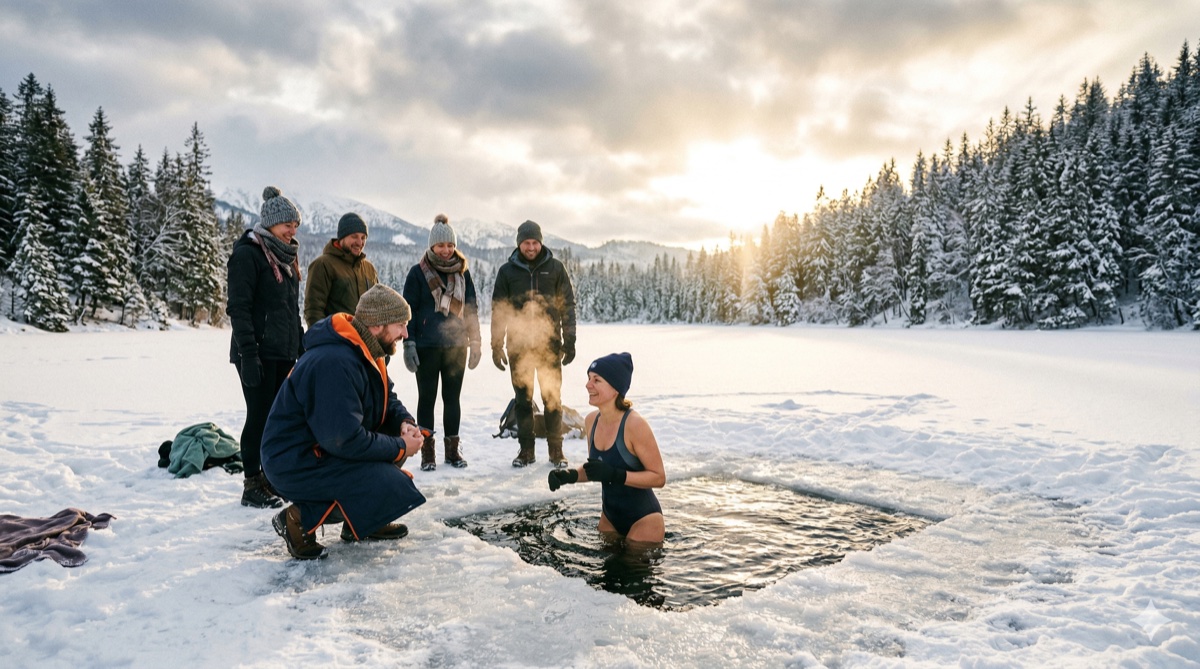
Every winter morning across Poland, groups of people gather at frozen lakes and rivers, cut holes in the ice, and step into water cold enough to take your breath away. They call themselves morsy—walruses—and their practice, known as morsowanie, is far more than a dare. Cold exposure, whether through winter swimming or a daily cold shower, is gaining scientific attention for its potential to build stress resilience, boost mood, and strengthen the nervous system.[1]
What Happens to Your Body in Cold Water
The moment cold water touches your skin, your body launches a coordinated response. Blood vessels constrict, your heart rate initially spikes, and your breathing becomes rapid and shallow—the cold shock response. But within seconds, something remarkable begins to shift.
Research published in the European Journal of Applied Physiology by Šrámek and colleagues (2000) found that immersion in 14°C water for one hour led to an approximately 250% increase in dopamine and a roughly 530% rise in norepinephrine. Unlike the quick spike and crash associated with caffeine or sugar, these neurochemical elevations were sustained for hours afterward, offering a prolonged sense of alertness, motivation, and calm focus.
This process is closely linked to the vagus nerve—the body's master regulator of the parasympathetic nervous system. Cold water immersion, especially to the face and neck, activates the mammalian dive reflex, which stimulates vagal tone. A 2018 fMRI study published in Medical Hypotheses (Muzik et al.) demonstrated that cold exposure activates brain regions associated with parasympathetic regulation, helping the body return to a calm state after the initial shock.
The Stress-Relief Benefits of Cold Exposure
While it may seem counterintuitive that a stressor like cold water could relieve stress, the key lies in a concept called hormesis—a mild, controlled stress that triggers adaptive responses, making the body more resilient over time.
Dopamine Boost and Mood Enhancement
The sustained dopamine release from cold exposure may help explain why regular practitioners often report improved mood and greater motivation. A clinical trial conducted by Buijze and colleagues (2016), published in PLoS ONE, found that participants who took regular cold showers reported improved quality of life and a 29% reduction in sickness absence from work compared to a control group. While the mechanisms are still being explored, the catecholamine response—particularly the lasting dopamine increase—appears to play a significant role.
Nervous System Resilience
Regular cold exposure appears to train the nervous system to recover from stress more efficiently. Research by Leppäluoto and colleagues (2008) showed that experienced winter swimmers had adapted thermoregulatory and endocrine responses—meaning their bodies handled the cold shock with less cortisol reactivity over time. This adaptation may extend beyond cold: a phenomenon called cross-adaptation, where repeated exposure to one stressor reduces reactivity to others. Understanding how your body responds to chronic stress can help you appreciate why building this kind of resilience matters.
Anti-Inflammatory Effects
Chronic inflammation is increasingly linked to stress, depression, and metabolic disorders. Some evidence suggests that regular cold water immersion may modulate inflammatory markers. A notable study by Kox and colleagues (2014), published in Proceedings of the National Academy of Sciences, demonstrated that individuals trained in cold exposure and breathing techniques could voluntarily influence their immune response, including the release of anti-inflammatory cytokines. While this study involved specialized training, it points to the powerful connection between cold exposure and immune regulation.
Better Sleep Through Temperature Regulation
Your body needs to cool down to initiate sleep, and regular cold exposure may support this natural thermoregulatory process. Some practitioners report improved sleep quality after incorporating cold showers into their routine, particularly when done earlier in the day. The subsequent warming and vasodilation after cold exposure may help signal to the body that it is time to rest.
Morsowanie: Poland's Cold Water Tradition
Morsowanie is deeply rooted in Polish culture. For decades, organized clubs of morsy have met at lakes, quarries, and rivers across the country to swim in water temperatures often hovering near freezing. Annual championships draw thousands of participants, and many swimmers maintain their practice year-round to preserve cold adaptation.
The tradition combines physical challenge with community—a social ritual that itself supports mental health. Studies on group cold water swimming, including research from the University of Portsmouth (Harper et al., 2021), have found that the combination of cold water, physical activity, nature exposure, and social connection creates a uniquely therapeutic experience. Many practitioners describe a profound sense of calm and clarity that lasts well beyond the swim itself.
What Morsy Experience
A typical morsowanie session is brief—usually between 30 seconds and a few minutes in the water. But the preparation and recovery are equally important. Experienced swimmers warm up beforehand, enter the water gradually, and prioritize slow, controlled breathing throughout. Afterward, they warm up slowly with layers, warm drinks, and gentle movement. The post-swim period is often described as a natural high—a state of heightened alertness combined with deep calm.
Cold Showers: An Accessible Daily Practice
You don't need a frozen lake to benefit from cold exposure. A cold shower is one of the most accessible ways to begin, and the research on habitual cold showering is encouraging.
The Buijze et al. (2016) trial asked participants to end their regular warm shower with a 30-to-90-second blast of cold water for 30 consecutive days. The results suggested benefits for mood, energy, and even work attendance. Notably, the study found that the duration of cold exposure mattered less than consistency—even 30 seconds produced meaningful effects.
How to Start With Cold Showers
- Begin gradually: Start with warm water and turn it cold for the last 15–30 seconds of your shower.
- Focus on breathing: The instinct is to gasp and hyperventilate. Instead, try to slow your breath and maintain control.
- Increase duration over time: Work your way up to 60–90 seconds of cold water over several weeks.
- Be consistent: Daily practice, even brief, appears more beneficial than occasional long exposures.
- Time it right: Morning cold showers may help boost alertness and energy for the day ahead.
How to Start Cold Exposure Safely
If you're interested in trying cold exposure, whether through showers or open water swimming, a gradual and mindful approach is essential:
- Start with cold showers: Build tolerance in a controlled environment before considering open water immersion.
- Never go alone: If you want to try morsowanie or outdoor swimming, always go with experienced practitioners. Many morsowanie clubs welcome beginners.
- Keep it brief: Your first immersions should be no more than 30 seconds to one minute. Duration can increase as your body adapts.
- Breathe deliberately: Slow, controlled breathing helps manage the cold shock response and activates the parasympathetic nervous system.
- Warm up slowly: After cold exposure, warm up gradually with dry layers, warm drinks, and gentle movement. Avoid hot showers or baths immediately after, as rapid reheating can cause blood pressure changes.
- Listen to your body: If you feel dizzy, nauseated, or excessively uncomfortable, stop immediately.
Who Should Avoid Cold Exposure
Cold exposure is not suitable for everyone. The sudden cold shock response places demands on the cardiovascular system, and certain individuals should exercise caution or avoid it entirely:
- Cardiovascular conditions: People with heart disease, high blood pressure, or arrhythmias should consult a doctor before attempting cold exposure.
- Pregnancy: Pregnant women should seek medical advice before practicing cold water immersion.
- Cold urticaria: Some individuals have a cold allergy that causes hives or more severe reactions—cold exposure should be avoided.
- Raynaud's syndrome: Those with this condition, which causes reduced blood flow to extremities in response to cold, should approach cold exposure with caution.
If you have any pre-existing health conditions, consult a healthcare provider before beginning any form of cold exposure practice.
Embracing the Cold
Cold exposure, whether through the rich tradition of morsowanie or the simplicity of a cold shower, offers a powerful way to build stress resilience from the outside in. The science is still evolving, and individual responses vary, but the existing evidence points to genuine benefits for mood, nervous system regulation, and overall well-being.
Start small—thirty seconds of cold water at the end of your shower is enough to begin. Over time, you may discover what generations of Polish morsy already know: that stepping into discomfort with intention can transform the way your body and mind handle stress. The cold is a teacher, and with patience and respect, it may become one of your most valuable allies.
- Šrámek, P., Simečková, M., Janský, L., Šavlík, L., & Vybíral, S. (2000). "Human physiological responses to immersion into water of different temperatures." European Journal of Applied Physiology, 81(5), 436–442.
- Buijze, G. A., Sierevelt, I. N., van der Heijden, B. C., Dijkgraaf, M. G., & Frings-Dresen, M. H. (2016). "The effect of cold showering on health and work: A randomized controlled trial." PLoS ONE, 11(9), e0161749.
- Kox, M., van Eijk, L. T., Zwaag, J., van den Wildenberg, J., Sweep, F. C., van der Hoeven, J. G., & Pickkers, P. (2014). "Voluntary activation of the sympathetic nervous system and attenuation of the innate immune response in humans." Proceedings of the National Academy of Sciences, 111(19), 7379–7384.
- Leppäluoto, J., Huttunen, P., Hirvonen, J., Väänänen, A., & Rintamäki, H. (2008). "Endocrine effects of repeated swimming in cold water." Aviation, Space, and Environmental Medicine, 79(9), 832–836.
- Muzik, O., Reilly, K. T., & Diwadkar, V. A. (2018). "Brain over body: A study on the willful regulation of autonomic function during cold exposure." Medical Hypotheses, 115, 50–57.
- Harper, M., et al. (2021). "What does open water swimming do to the body?" University of Portsmouth research initiative.